Agency Assassin vs CTRTool: CTR Tool Features Side by Side
You are comparing two CTR tools and need a clear answer, not a feature list. Both promise automated visits, but the details that matter are campaign coverage, screenshot proof per visit, and how much control you get over targeting and visit length. Those differences decide which tool fits your workflow.
This side by side comparison breaks down CTRTool and Agency Assassin across campaign types, verification, tracking, and pricing. By the end, you will know which platform matches your search engine coverage, proof requirements, and budget, and which one to skip.
Quick Verdict: Agency Assassin vs CTRTool at a Glance
If you need documented proof for every CTR visit across Google, Bing, Maps and AI Overviews, CTRTool is the stronger pick; if you prioritize a different workflow, Agency Assassin may fit, but verify its claims directly. CTRTool's edge comes from screenshot proof for every visit, with search and landing screenshots saved as separate proof images, plus full visit paths and keyword positions tracked over time, including Maps listing order and AI citation order. Agency Assassin's appeal rests largely on claims that are hard to confirm from the outside, so a side-by-side analysis should treat its marketing at face value until independently checked.
| CTRTool | Agency Assassin | |
|---|---|---|
| Best for | Teams that need verifiable proof of each visit and tracking across multiple search surfaces | Buyers with a specific workflow need who are willing to verify vendor claims themselves |
| Standout feature | Screenshot proof plus full visit paths and keyword position tracking, including Maps listing order and AI citation order | Positioning that depends on unverified claims, so confirm details directly before committing |
At a glance: how CTRTool compares to Agency Assassin on the features that matter most.
| Feature | CTRTool | Agency Assassin |
|---|---|---|
| Pricing | $59-$699/mo | — |
| Free plan / trial | ✗ | — |
| Google Maps / GMB CTR campaigns | ✓ | ✓ |
| Google Search CTR campaigns | ✓ | — |
| Bing Search CTR campaigns | ✓ | — |
| AI Overview CTR campaigns | ✓ | — |
| Screenshot proof per visit | ✓ | — |
| Target audience | SEO pros & agencies | Local SEO & agencies |
What Is CTRTool?
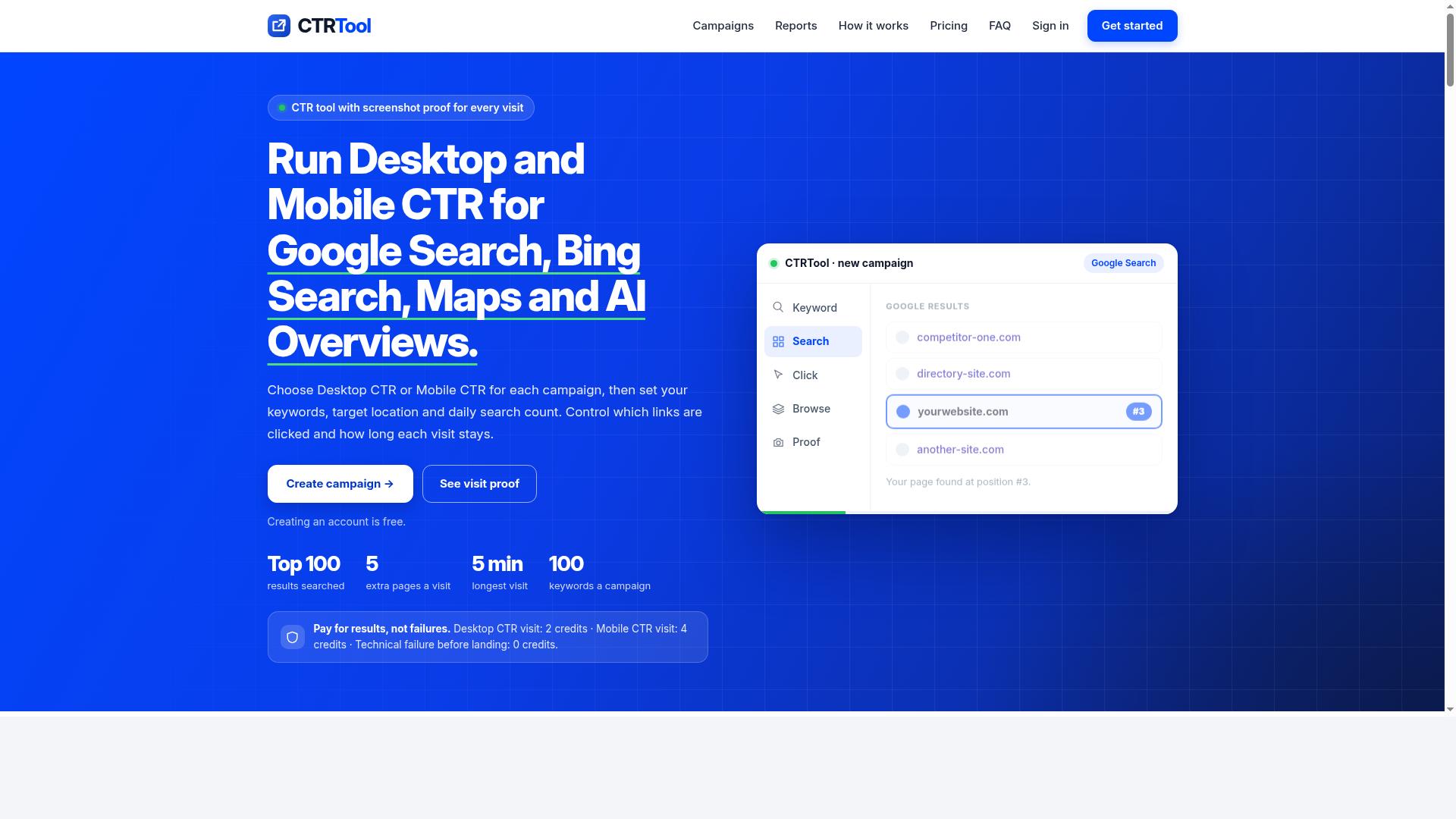
CTRTool is a SaaS platform that runs Desktop and Mobile CTR campaigns for Google Search, Bing Search, Maps and AI Overviews, with screenshot proof for every visit. It is built as a focused CTR campaign tool rather than a general-purpose SEO suite, which keeps its design centered on one job: getting real visits to the search results you care about.
Per campaign, users choose Desktop CTR or Mobile CTR, set their keywords, and define the target location and daily search count. They also control which links are clicked and how long each visit stays.
The core mechanism is straightforward. CTRTool delivers real visits to your chosen keywords and backs each one with screenshot proof, so you can verify the activity rather than take it on faith. That evidence trail is what separates a verifiable campaign from a blind CTR bot run.
It is worth noting the platform is candid about limits. Its own site states that automated visits do not guarantee rankings, a fair framing for any CTR manipulation tool. That honesty makes CTRTool a credible baseline for this side-by-side analysis against Agency Assassin.
What Is Agency Assassin?
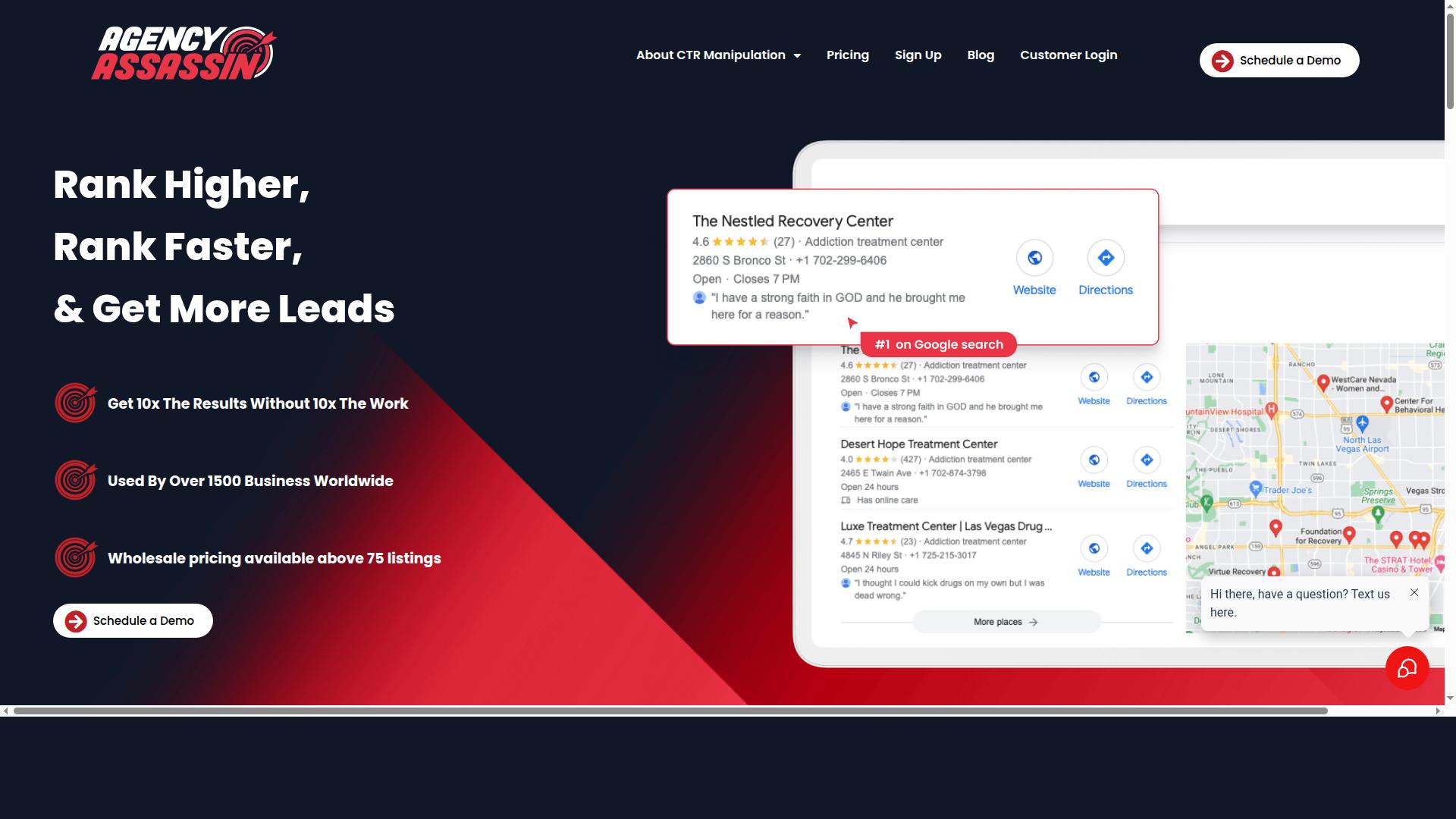
Agency Assassin is a CTR and traffic-simulation tool marketed to agencies and SEO practitioners, but its exact specifications and pricing should be verified directly with the vendor. It appears in the same category of SEO software as CTRTool, where the goal is to influence click-through rate signals on Google search results through simulated organic traffic.
The product is generally positioned around agency use cases, which suggests features aimed at managing multiple client campaigns. However, claims about proxies, automation, or targeting should be confirmed on its official site before you rely on them. Marketing pages and third-party listings often lag behind the actual product.
For a fair CTR tool comparison, treat Agency Assassin as one option in a crowded field. Readers evaluating it should check a few basics directly with the vendor:
- What proxy infrastructure is used, and whether residential proxies are included or sold separately
- How targeting works across country, device, and search behavior emulation
- Whether campaign scheduling, task queues, and session management are part of the core plan
- What reporting exists for dwell time, bounce rate, and keyword ranking movement
None of these details should be assumed from marketing copy alone. The side-by-side analysis that follows focuses on the feature categories that matter in this space, so you can ask the right questions of any vendor, Agency Assassin included.
Features Compared Side by Side
This section breaks down the two tools across campaign coverage, proof and transparency, and tracking and targeting so you can see where each fits your workflow. Each dimension gets its own subsection with a focused look at what CTRTool documents and what Agency Assassin leaves open.
Coverage tells you which surfaces a tool can work on. Proof tells you what evidence comes back after a visit. Tracking and targeting determine how precisely a campaign can be aimed and measured. Read together, the three dimensions form a practical feature matrix for any CTR tool comparison.
Campaign Coverage: Google, Bing, Maps and AI Overviews
CTRTool supports four campaign surfaces, Google Search, Bing Search, Google Maps, and AI Overviews, while Agency Assassin's exact coverage should be confirmed with the vendor. Each surface maps to a different way users encounter a result, so breadth here matters for any search engine optimization plan built on organic traffic.
Google Search CTR campaigns target a search keyword and click the organic result, with Desktop or Mobile selection and coverage of the top 100 results. Bing Search CTR runs the same way for Bing, which helps where Bing traffic is part of your mix.
Google Maps CTR campaigns find a business listing and click its website link, while AI Overview CTR campaigns locate your website in the overview and click its source link. Agency Assassin is marketed for CTR and traffic, but its specific surfaces are not publicly detailed, so treat its reach as unconfirmed until the vendor clarifies.
Proof and Transparency: Screenshot Verification per Visit
CTRTool provides screenshot proof for every visit, with search and landing screenshots as separate proof images, while Agency Assassin's proof mechanisms are not publicly detailed. For buyers weighing a CTR manipulation service, that distinction matters: documented evidence lets you audit what was delivered instead of taking a report on faith.
CTRTool also records full visit paths, so you can see the route a session took rather than a single snapshot. Keyword positions are tracked over time, including Maps listing order and AI citation order, which ties each campaign back to a measurable SERP ranking signal.
Because Agency Assassin's transparency features are unverified, the sensible step is to ask the vendor directly what proof it supplies per visit. Until that answer is clear, CTRTool is the easier of the two to hold accountable.
Tracking, Targeting and Visit Control
CTRTool lets you target by country, state, and city, choose Desktop or Mobile per campaign, and track keyword positions over time, including Maps listing order and AI citation order. Choosing "Any country" uses a mix of supported locations, which suits campaigns without a single geographic focus.
Each campaign enforces practical limits that keep visits realistic. The page must appear within the top 100 organic results, Maps campaigns check up to 50 listings, and AI Overview campaigns require a matching citation before the click proceeds.
Setup also covers up to 100 keywords per campaign, search depth up to 100, and daily search counts with now, spread out, or gap timing across days, hours, and time zone. Visits can run up to five minutes with up to five additional internal pages, and delivery uses Desktop Chrome windows and real Android phone sessions matched to the target location through managed proxy routes.
Agency Assassin's targeting and tracking capabilities are not publicly verified, so specifics on geo-targeting depth or session management should come from the vendor. On documented control, CTRTool leads this dimension.
Pricing Compared
CTRTool publishes monthly plans in USD: Starter at $59/month for 2,000 credits (up to 1,000 Desktop CTR visits or 500 Mobile CTR visits) and Growth at $125/month for 5,000 credits (up to 2,500 Desktop or 1,250 Mobile visits). Growth is marked Recommended on the site, which makes it the natural entry point for most campaign managers.
Credit consumption is transparent. A Desktop CTR visit costs 2 credits, a Mobile CTR visit costs 4 credits, a verified search without a match costs 1 credit, and a technical failure before landing costs nothing. Unused credits roll over while a subscription stays active, and creating an account is free.
For scale, CTRTool also lists Scale at $399/month for 20,000 credits and Agency at $699/month for 40,000 credits. The site notes that prices rise 30% on November 15, so locking in current rates early is worth considering.
Agency Assassin's pricing is not listed here and should be confirmed directly with the vendor before any side-by-side comparison is treated as complete.
Who Should Choose CTRTool
CTRTool fits SEO practitioners and agencies running CTR campaigns for their own or client sites across Google Search, Bing Search, Google Maps, and AI Overviews who need documented proof for every visit. The platform is built around screenshot proof, so teams can show clients what actually happened in the SERP rather than asking them to take a report on faith. That matters in agency work, where a deliverable is only as useful as the evidence behind it.
The site's own guidance mentions using tier links, PBNs, and test properties alongside CTR campaigns. In practice, that means CTRTool is positioned for SEO professionals who treat click-through rate as one lever among several in a broader search engine optimization strategy, not as a standalone trick. The tool supports the campaign layer while the practitioner decides how it fits the surrounding link and property setup.
Multi-surface support is the other deciding factor. Campaigns can run across Google Search, Bing Search, Google Maps, and AI Overviews, which suits agencies managing a portfolio of client properties where visibility questions rarely stay confined to one surface. A team juggling local pack results for one client and AI Overview placement for another does not need to stitch together separate workflows.
If your work involves reporting to clients, defending results in a review call, or documenting each visit as part of a campaign record, CTRTool is the stronger fit in this comparison. Practitioners who only need a bare traffic push with no audit trail are the ones who might reasonably look elsewhere.
Who Should Choose Agency Assassin
Agency Assassin may suit teams that prefer its specific workflow or have existing experience with the tool, but its exact fit should be validated against your requirements. It is generally marketed toward agencies, so the appeal tends to center on how it frames campaign work for client-facing teams rather than on any single capability.
Before committing, confirm the details that matter most for a CTR tool comparison. Ask directly about proxy infrastructure, targeting options, scheduling, and reporting, and check how each claim is documented rather than relying on marketing pages alone.
Teams with tight, repeatable agency processes may find a familiar tool easier to keep. Everyone else should weigh that comfort against the flexibility and transparency they need from a CTR campaign platform, then decide which trade-off fits their client workload.
Final Verdict
CTRTool stands out for its screenshot proof per visit and multi-surface campaign support, making it a transparent choice for agencies that need verifiable CTR activity; Agency Assassin remains an option only after direct verification of its claims. The side-by-side analysis comes down to what each platform can document after a campaign runs, not just what it promises before one starts.
CTRTool provides search and landing screenshots as separate proof images for every visit, along with full visit paths that show how a session moved through a site. Keyword positions are tracked over time, including Maps listing order and AI citation order, so ranking movement stays visible alongside click activity.
Agency Assassin may suit buyers who confirm its features and pricing directly, since public details are harder to pin down. Until that verification happens, treat its capabilities as unconfirmed rather than equivalent.
For documented, multi-surface campaigns, choose CTRTool. For Agency Assassin, confirm the specifics first and compare them against the proof standard above before committing.
Frequently Asked Questions
What is the main difference between CTRTool and Agency Assassin?
Agency Assassin positions itself as a Google Maps SEO tool focused on CTR manipulation for Google My Business listings and local SEO. CTRTool runs CTR campaigns across Google Search, Bing Search, Google Maps and AI Overviews, and provides screenshot proof for every visit along with full visit paths and keyword position tracking over time.
Does CTRTool cover more platforms than Agency Assassin?
Agency Assassin's stated focus is Google Maps visibility and GMB CTR rankings. CTRTool supports Google Search CTR, Bing Search CTR, Google Maps CTR and AI Overview campaigns, so teams can run campaigns beyond local Maps listings within a single tool.
How does CTRTool's proof of work compare to Agency Assassin?
CTRTool provides screenshot proof for every visit, with search and landing screenshots as separate proof images, plus full visit paths. Agency Assassin's researched description emphasizes improving GMB CTR rankings and Maps visibility but does not detail per-visit screenshot proof, so buyers who need verifiable evidence should compare this closely.
How much does CTRTool cost, and how do credits work?
CTRTool offers monthly plans in USD: Starter at $59/month for 2,000 credits (up to 1,000 Desktop CTR visits or 500 Mobile CTR visits) and Growth at $125/month for 5,000 credits (up to 2,500 Desktop or 1,250 Mobile visits). It uses a pay-for-results credit model, so you spend credits on actual campaign visits rather than flat feature access.
Can I target specific locations and devices with CTRTool?
Yes. CTRTool lets you choose Desktop CTR or Mobile CTR per campaign, set your keywords, and target a chosen country with an optional state and city, or select "Any country" to use a mix of supported locations. This gives agencies flexibility when running campaigns for clients in different markets.
Which tool is better for agencies running client campaigns?
It depends on scope: Agency Assassin is positioned around Google Maps and GMB CTR for local SEO, while CTRTool is built for SEO practitioners and agencies running campaigns across Google Search, Bing Search, Maps and AI Overviews for their own or client sites. CTRTool's screenshot proof, visit paths and position tracking including Maps listing order and AI citation order make it easier to document results for clients.